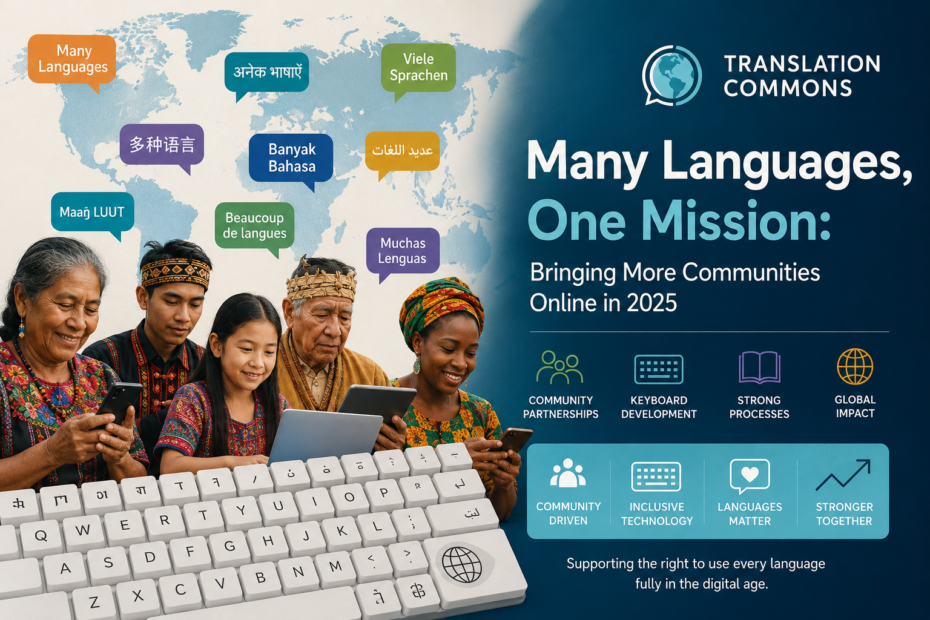
The Keyboard Group at Translation Commons is a group of volunteers that has as its goals to develop as many digital keyboards as possible for languages that do not currently have a suitable one. We also work to engage, train and support those who want to develop keyboards, streamline the development process and raise awareness of keyboard development, and the need for such activities.
In 2025, we made great progress towards these goals, in particular on defining clearer processes, building stronger community partnerships and making meaningful progress across a number of keyboard projects for Indigenous and under-resourced languages.
Processes: A Strong Framework for Growth
Much of this year’s impact came from behind‑the‑scenes work that will positively impact the future of our keyboard efforts. The team streamlined its development workflows, clarified documentation standards, and mapped out a long‑term publishing strategy. Activities included: establishing a unified tracking system for all language projects; setting up a scalable GitHub repository structure and publishing workflow; improving installation guides for all platforms; drafting best-practice guidelines for community consultations and submissions to Keyman.
By investing in those foundational activities we ensure that as we increase our reach and collaborate with increasing numbers of communities and organisations, we are able to provide consistent, scalable and sustainable support.
A Productive Year for Development
On the development front, work advanced on numerous keyboards. In some cases, such as Kissi, Chakma, Chatino, among others we updated and tested previously published keyboards in order to add them to our GitHub repository. We delivered prototypes for feedback on Ho-Chunk and Oneida, while continuing work on a number of others such as Cowlitz, Dogon, Hunde, Kalabari, Colville Salish, Kiowa, Kirikiris (Wichita), Kpelle, Laz, Lushootseed, Mingrelian, Miship, Penobscot, Potawatomi, Pular, Quileute, Tangsa, Tunica, and Wolastoqey-Metahsonekiyak (Maliseet). As we are committed to iterative, community-driven development, the timelines from initiation of a project to final release can be quite long, yet it is essential to ensure that our keyboards address community needs and are created collaboratively with strong community involvement. You can find a list of our published keyboards.
Beyond working on keyboards directly, we also supported students at the University of Limerick where students created a keyboard testing and learning platform and explored AI‑assisted keyboard generation and evaluation. We are looking forward to exploring how these approaches will help accelerate and democratise the keyboard development process in the future.
Stronger Partnerships and Broader Outreach
A major highlight of 2025 was our deepening engagement with communities, researchers, and organizations across the language‑technology landscape. We presented at the Unicode Technology Workshop on AI in keyboard development, continued our collaboration with Unicode CLDR on keyboard documentation, created new outreach materials to help communities understand the development process, and added an Community Success Stories section to the TC website to showcase community successes. Participation in events such as LT4All in Paris further strengthened connections with global language‑rights and digital‑inclusion movements.
Setting the Stage for a Successful 2026
By the end of 2025, the Translation Commons Keyboard Group had not only delivered new keyboards but also built the foundation for faster, more community‑centered development in the years ahead. In 2026 we will continue to support the right for every community to use their language fully in the digital age.
You can get involved
It is important to us that what we do is useful and effective, so we welcome your thoughts and suggestions.
You can learn more about the Translation Commons Keyboard Creation Project on the project page. If you’re interested in volunteering with us, visit our Volunteer page.
Are you a member of a language community or other community advocate that would benefit from a keyboard for your language? You can request a keyboard design and implementation.
Dr. Tabea De Wille
Dr. Tabea De Wille is Associate Professor in the Department of Computer Science and Information Systems at the University of Limerick. Among other projects, she is part of the Keyboard group at Translation Commons and writes about the group’s activities.